AI Trends & Future Workforce Research
2026
Personal Research
Background: Navigating the AI Space in 2026
Artificial Intelligence is rapidly transforming industries, workflows, and the way people interact with technology. As AI adoption accelerates, discussions often focus on either the capabilities of AI or the fear of replacement, overlooking the importance of understanding how humans and AI can effectively collaborate. This personal research project explores the evolving relationship between human capabilities and artificial intelligence, examining how different disciplines can leverage AI while maintaining human judgment, creativity, ethics, and strategic thinking. The project culminated in a series of infographic posters designed to simplify complex concepts and provide a visual framework for understanding Human-AI collaboration in 2026.

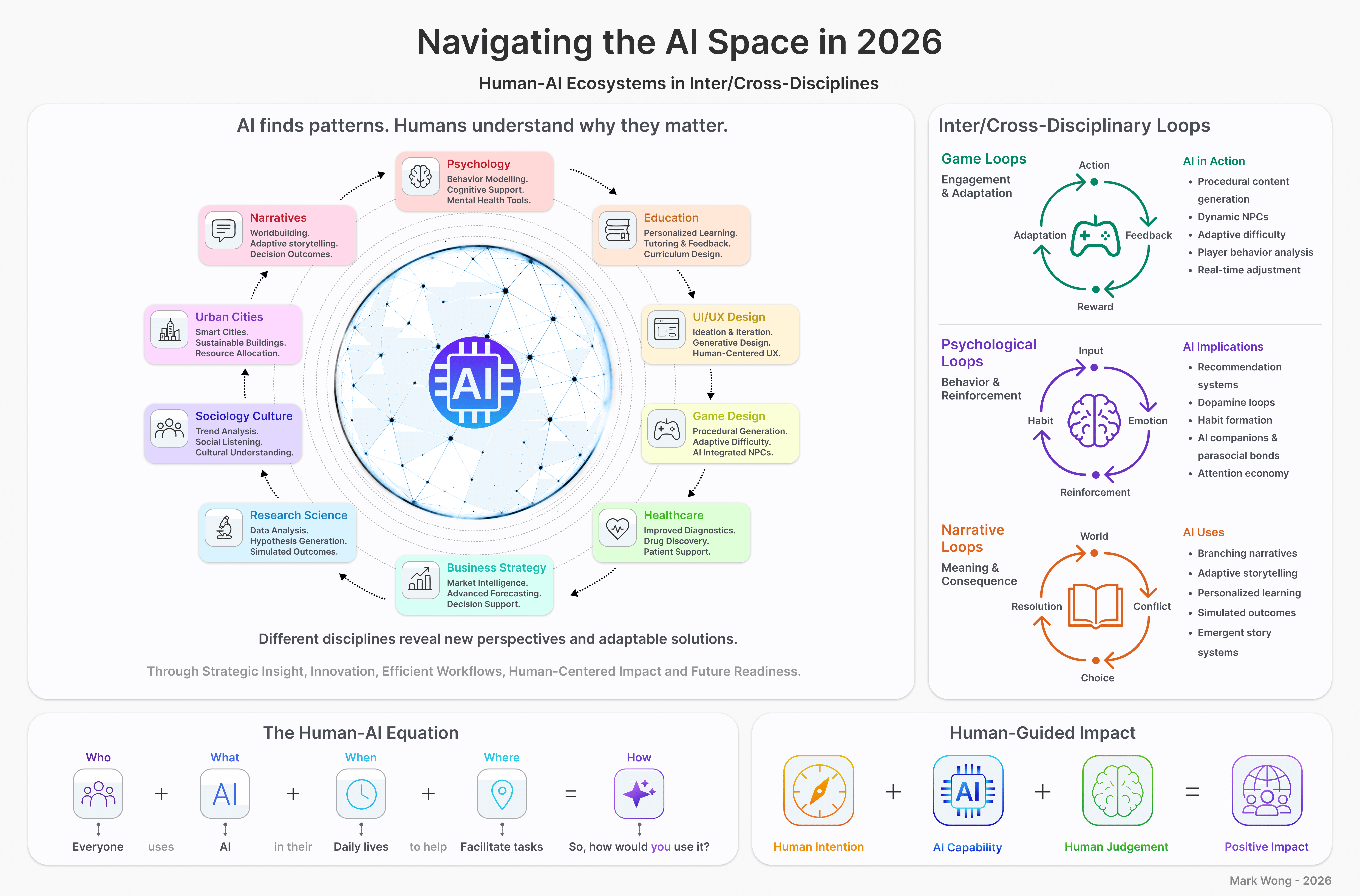
Preview Infographics Poster 1 | Preview Infographics Poster 2
Goals:
Research how AI is transforming industries, workflows, and decision-making processes across multiple disciplines.
Identify the strengths and limitations of both humans and artificial intelligence in modern work environments.
Develop a visual framework that helps individuals understand where AI creates value and where human expertise remains essential.
Translate complex interdisciplinary research into accessible infographic posters that support learning, discussion, and strategic planning.
Design Challenges:
The AI landscape evolves rapidly, making it difficult to distinguish long-term trends from short-term hype and emerging technologies.
Research findings often exist in isolated disciplines, requiring synthesis across psychology, education, healthcare, business, game design, UX, sociology, and storytelling.
Balancing optimism and caution was important to avoid presenting AI as either a replacement for humans or a purely supportive tool.
Simplifying highly complex systems, feedback loops, and interdisciplinary relationships into digestible visual narratives without losing nuance.
Creative Strategy:
Conducted extensive research using academic sources, industry reports, articles, and AI-assisted discovery methods to accelerate information gathering and comparison.
Applied interdisciplinary thinking to identify recurring patterns between fields such as psychology, game design, UX research, education, business strategy, and healthcare.
Mapped areas where humans excel in including creativity, ethics, context, social intelligence, and strategic thinking against areas where AI excels, such as automation, scale, simulation, pattern recognition, and accessibility.
Developed visual frameworks illustrating Human-AI Synergy, cross-disciplinary ecosystems, feedback loops, and decision-making models to communicate relationships between concepts.
Used AI as a research accelerator and synthesis tool while maintaining human oversight to validate findings, identify connections, and curate meaningful insights.
Designed infographic posters using a clean, systems-oriented visual language that prioritizes hierarchy, accessibility, and rapid comprehension.
Outcome:
Through this project, I created a series of research-driven infographic posters that visualize how humans and AI can collaborate rather than compete. By synthesizing insights across multiple disciplines, I developed a framework that highlights the unique strengths of both humans and artificial intelligence while illustrating how they intersect to create new opportunities for innovation.
The final visuals transformed a broad and often overwhelming topic into a structured, accessible knowledge system that can be used for education, strategic discussions, and future planning. More importantly, the project allowed me to explore how research, storytelling, systems thinking, and design can work together to communicate emerging technological trends in a meaningful way.
Insights & Takeaways:
This project reinforced my belief that AI is most effective when viewed as a collaborative tool rather than a replacement for human expertise. While AI excels at processing information, identifying patterns, and accelerating workflows, humans remain critical for providing context, judgment, ethics, creativity, and long-term strategic direction.
I discovered that many challenges surrounding AI are not purely technological problems but interdisciplinary ones. Psychology, education, business, healthcare, storytelling, UX, and game design all reveal different perspectives on how AI influences human behaviour and decision-making.
The research process also strengthened my ability to synthesize information from diverse sources into cohesive frameworks. By combining traditional research methods with AI-assisted exploration, I was able to rapidly identify patterns, test ideas, and visualize complex relationships that would have been significantly more difficult to uncover through a single disciplinary lens.
Most importantly, this project reinforced my interest in operating at the intersection of research, systems thinking, storytelling, and design, translating complexity into clarity so that emerging technologies can be understood, evaluated, and applied more effectively.
Designing innovative and immersive digital experiences.
